
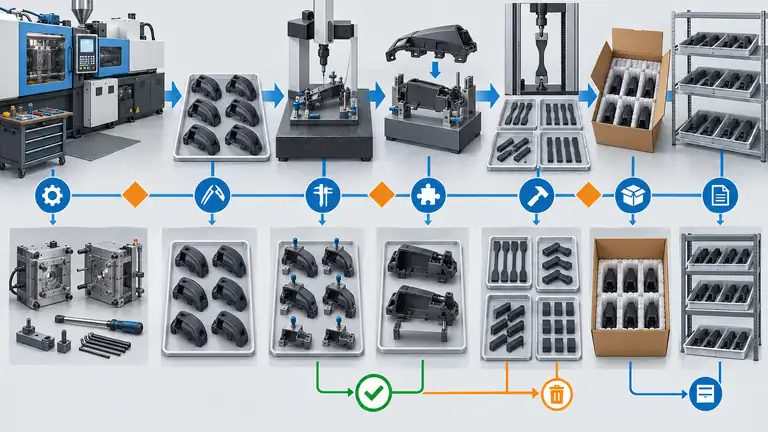
Conceptual illustration; not to scale.
Home › Blog › Planning a Pilot Production Run for Automotive Plastic Parts
Automotive sourcing and manufacturing decision guide
Pilot runs often begin with a round quantity—“make 300 parts”—without deciding who needs the samples or what each group must prove. Parts are then double-booked for assembly and destructive testing, cavities lose traceability, changed revisions are mixed, and the build consumes time without closing the decision that justified it.
Plan a pilot from decisions backward. Define product, process, assembly, test, packaging, and release objectives; run under intended serial conditions; allocate uniquely identified samples by cavity, lot, and destination; and give every objective an owner, method, evidence record, acceptance condition, and disposition route. The customer’s requirements determine the actual population—there is no universal pilot quantity.
The useful deliverable is not a pile of samples. It is a traceable matrix connecting each open question to the right production condition, sample population, result, and authorized next step.
In This Guide
- Define What the Pilot Must Validate
- Define the Intended Conditions and Allowed Deviations
- Illustrative Pilot Sample Allocation
- Pilot Plan: Objective, Sample Use, Evidence and Release Condition
- Close Issues Without Mixing Revisions or Sample Populations
- Record a Bounded Pilot Decision
Define What the Pilot Must Validate
Why this matters: When “validate the part” is the only objective, teams collect unrelated results without knowing which product, process, or delivery decision they support. Gaps appear after the sample population has been consumed.
Convert every open risk into a specific pilot question and classify it as product, process, assembly, packaging, or decision evidence. Define the requirement, method, population, owner, and pass or disposition rule before scheduling the run.
A pilot is useful when it converts open questions into evidence. List each question before the run: can all cavities make dimensionally acceptable parts; do parts assemble at tolerance limits; does the function remain acceptable after environmental conditioning; can packaging protect the approved condition; can production records preserve traceability?
Separate product questions from process questions. A functional test can confirm that selected samples met a requirement, while the production record shows whether the intended route repeatedly created those samples. Neither result automatically proves the other.
Identify destructive and non-destructive work. Parts consumed by sectioning, pull testing, flammability, impact, chemical exposure or thermal aging cannot also become retained masters or assembly-build stock.
Begin with the latest design, process, and program risk records, then interview the functions that will use the output. Design may need interface fit; manufacturing may need cavity balance and stable handling; quality may need dimensional, measurement, and traceability records; the customer plant may need an assembly build; logistics may need a pack trial; purchasing may need confirmation of the proposed route. Consolidate overlapping needs, but do not combine tests merely to reduce sample count when conditioning or destructive work makes the populations incompatible.
Use an objective register as the planning tool. Recommended columns are objective ID, decision question, applicable revision, characteristic or requirement, sample source, cavity/lot coverage, preconditioning, method, quantity basis, destructive status, owner, evidence, acceptance authority, and fallback action. Illustrative use scenario: engineering requests 40 clips for mating evaluation and the laboratory requests 30 for insertion/retention testing after heat aging. Because aged pull-test samples cannot serve as untouched assembly references, the register allocates separate populations and identifies control samples before production starts.
Product evidence
- Dimensions and geometry
- Appearance and boundary condition
- Assembly fit and interface
- Functional and environmental performance
Process evidence
- Cavity and cycle stability
- Material/process traceability
- Inspection readiness
- Downstream work and packaging
Decision evidence
- Issue disposition
- Deviation authority
- Retained reference set
- Named release approval
Define the Intended Conditions and Allowed Deviations
Why this matters: A pilot made with prototype fixtures, extra inspection, different resin, or an alternate press can answer selected questions but may conceal risks in the intended serial route.
Freeze intended conditions and compare them line by line with the actual run. Document substitutions and temporary controls, restrict the conclusion they support, and plan closure under serial conditions where equivalence is not demonstrated.
A production-representative run should exercise the intended tool, equipment, environment, operators and cycle. Volvo Group’s public supplier quality manual uses those conditions for its significant production run and says sample quantity depends on the equipment, tooling and process. The customer’s plan—not this article—sets the actual quantity and approval route.
Record the drawing/CAD revision, tool and cavity IDs, press and auxiliaries, resin grade/color/lot, drying and regrind rule, process/program revision, operators, fixtures, inspection method, assembly components and packaging. Freeze those conditions before selecting samples.
If serial equipment is unavailable, identify the substitute and the risk it leaves open. An extra operator, temporary fixture or off-line inspection can help learn, but it must not be presented as proof that the future production route is ready.
Define startup and stabilization output separately from accepted pilot output. Setup pieces, purges, short shots and parts made before the agreed sampling point should remain traceable but should not be silently added to validation sample counts.
Create a pilot-baseline sheet covering part and drawing revision, tool and cavities, press and auxiliaries, material manufacturer/grade/color/lot, drying and regrind, process-program revision, operators, standard work, fixtures, gauges, downstream components, label, packaging, and data systems. Identify the approved setup and stabilization rule. If texture, automation, production gauges, or final packaging are not ready, say so in the plan and decide which objectives remain valid despite that limitation.
At the pre-run meeting, walk the physical route and compare it with the sheet. Temporary 100% visual sorting can protect a customer build, but it does not validate a future sampling plan. Manual insert loading may support interface evaluation but not automated cycle or error-proofing evidence. A different press may affect process transfer, residence time, pressure capability, or robot handling. Record the reason, risk, owner, and closure event for every deviation. This lets the team use valuable pilot learning without overstating production readiness.
Illustrative Pilot Sample Allocation
Why this matters: Sample counts become unreliable when one part is promised to multiple users, destructive tests are not identified, or cavity and material-lot coverage is decided after the run. The evidence set can no longer be reconstructed.
Allocate accepted samples before the run using unique IDs and a ledger. Tie each population to its objective, cavity and lot coverage, conditioning, destination, destructive status, reserve rule, and evidence owner; keep setup and rejected pieces outside accepted allocations.
Illustrative example — assumptions: a four-cavity tool, 240 accepted and traceable pilot pieces after documented setup/stabilization, one material lot, and customer-defined tests. The quantities below demonstrate allocation logic only. They are not PPAP, OEM or industry minimums.
Allocate by objective and cavity/lot coverage. Keep a sample ledger so one serial number cannot be promised to two destructive destinations.
Use the illustrative 240-piece table by asking whether each row has a justified quantity basis, not whether 240 is appropriate for your program. Five pieces per cavity may illustrate a dimensional layout, but a released drawing, customer plan, risk, and statistical method must determine actual coverage. Assembly builds depend on build combinations and failure-learning needs. Environmental and functional groups depend on the test method, controls, conditioning, replicates, and allowance for invalid tests. Packaging depends on the full pack and handling route. Retained samples need a custodian and defined condition.
Illustrative use scenario: a four-cavity run yields 240 accepted pieces from one material lot. The ledger assigns each serial ID to dimension, assembly, conditioned function, destructive sectioning, packaging, or retention. If an assembly team later requests ten more, the planner checks unassigned reserve or obtains an authorized reallocation; it does not borrow aged test specimens or retained masters. If one cavity produced fewer accepted parts, the shortfall remains visible and the affected objectives are reviewed rather than filled with unidentified pieces from another cavity.
| Sample group | Purpose and quantity basis |
|---|---|
| Dimensional layout — 20 | Use: five identified pieces per cavity. Basis: illustrative cavity coverage. Evidence: report to released drawing and measurement method. |
| Assembly evaluation — 80 | Use: mating build across agreed part variation. Basis: customer build plan. Evidence: fit/interference/issue log and assembly disposition. |
| Functional and environmental — 60 | Use: preconditioned test groups and controls. Basis: test matrix and method. Evidence: sample IDs, conditions, results and acceptance decision. |
| Destructive work — 40 | Use: sectioning, force or other consumed tests. Basis: replicates and invalid-test allowance. Evidence: raw data, failure mode and sample disposition. |
| Packaging trial — 20 | Use: pack orientation, handling and transport simulation where required. Basis: pack quantity and route. Evidence: pack instruction and post-test condition. |
| Retained set — 20 | Use: controlled reference and issue recheck. Basis: customer/supplier retention plan. Evidence: sealed IDs, storage condition, custodian and expiry/review date. |
Pilot Plan: Objective, Sample Use, Evidence and Release Condition
Why this matters: A calendar and sample total do not define a pilot plan. Without owners, methods, evidence, and release conditions, finished tests can still leave the program unable to decide what happens next.
Build a decision matrix in which every objective has controlled inputs, sample use, quantity basis, method, evidence record, owner, acceptance authority, and explicit release or escalation condition.
Write the plan so every objective has an owner and a decision rule before samples exist.
Use the plan table during three reviews. At readiness, confirm that the revision, tools, materials, methods, fixtures, laboratories, mating parts, packaging, and recipients will be available. At execution, record actual conditions and sample IDs against the planned rows. At closeout, attach results and disposition every exception. A row is not complete because samples were shipped; it closes only when the intended evidence exists and the named authority has accepted, rejected, or formally deviated the result.
Sequence the populations carefully. Capture as-molded dimensions or weight before destructive sectioning. Preserve control samples before environmental conditioning. Confirm whether assembly parts will be returned and whether their condition permits later work. Schedule external laboratories around sample preparation and transit, and identify what happens if a test is invalid. The table is also a logistics tool: labels, containers, chain of custody, destination contacts, and due dates prevent technically valid samples from becoming unusable because their identity or history is lost.
| Pilot objective | Evidence and release condition |
|---|---|
| Dimension and appearance | • Objective: verify released geometry/visual baseline • Sample use: identified cavity/lot distribution • Quantity basis: drawing and customer sampling plan • Evidence: raw data, report and boundary records • Release: authorized disposition of every nonconformance |
| Assembly and interface | • Objective: verify mating stack and installability • Sample use: representative build combinations • Quantity basis: assembly-risk plan • Evidence: build record, force/fit observations and issues • Release: interface owner accepts or assigns correction |
| Functional/destructive | • Objective: test named requirement after conditioning • Sample use: control and exposure groups • Quantity basis: test method/customer plan • Evidence: traceable laboratory/test record • Release: result meets criterion or approved deviation exists |
| Process and traceability | • Objective: confirm intended route creates identifiable output • Sample use: full pilot population • Quantity basis: enough output for planned checks • Evidence: process, material, cavity and inspection records • Release: unresolved process deviations are closed |
| Packaging and delivery | • Objective: preserve part condition to use point • Sample use: complete pack/handling path • Quantity basis: pack design and test route • Evidence: approved instruction and inspection • Release: damage/contamination/label risks accepted |
| Retained references | • Objective: preserve a comparison set • Sample use: untouched identified parts • Quantity basis: retention agreement • Evidence: storage log and photographs if authorized • Release: custodian, condition and replacement rule defined |
Close Issues Without Mixing Revisions or Sample Populations
Why this matters: Pilot results are easily contaminated when failed samples disappear, replacement tests are undocumented, or corrections create a new revision that is pooled with the original population. Apparent closure then lacks a valid baseline.
Control every issue and replacement through sample IDs, revision impact, root cause, containment, correction, repeat scope, and authorized disposition. Preserve failed and invalid records, and never combine pre-change and post-change evidence without an approved rationale.
Give every issue an ID, affected sample IDs/cavities, requirement, evidence, containment, owner, due date and disposition authority. When a correction changes tool steel, process, resin, component or drawing, state which pilot evidence remains valid and what must be repeated.
Do not replace failed data with unplanned “good” samples. If a test is invalid because of laboratory or fixture error, preserve the invalid record, explain the cause and authorize the replacement sample set.
Keep retained parts subordinate to released data. A retained sample can clarify appearance or a physical condition, but it cannot authorize an out-of-tolerance dimension or an undocumented design change.
Use an issue log linked to the objective register. Record the requirement, observed condition, affected cavities and sample IDs, date, material lot, method, immediate containment, suspected and verified cause, corrective action, owner, due date, and authority. Distinguish a true nonconformance from an invalid test caused by equipment, fixture, conditioning, or procedural error. Both records remain part of the history; an invalid result requires a documented reason and an authorized replacement population rather than deletion.
Perform a change-impact review before rerun. A local steel correction may require targeted dimensions and mating checks, while a gate, cooling, process-window, or material change can affect warpage, appearance, strength, cycle, and multiple cavities. Update drawings, risk analysis, process documents, inspection instructions, and sample labels as applicable. Illustrative scenario: an insert is corrected after the first 120 samples. The remaining 120 are not a continuation of one population; they are post-change samples under a new tool state and must be evaluated against a revised plan.
Disposition choices
- Accept to requirement
- Rework/retest under approved method
- Correct tool/process and repeat affected evidence
- Approve time-bounded deviation
- Reject and reopen design/process decision
Revision firewall
- No mixed CAD/drawing revisions
- No unrecorded material substitution
- No pooled unidentified cavities
- No reused destructive samples
- No changed acceptance rule after seeing results
Record a Bounded Pilot Decision
Why this matters: The phrase “pilot passed” can be misread as approval for production or shipment even when only an assembly build succeeded and process, capacity, packaging, or customer records remain open.
Issue a bounded closeout that identifies represented conditions, completed objectives, sample populations, results, deviations, open actions, and the precise next activity authorized. Keep pilot acceptance separate from formal customer or production release.
The closeout should state what passed, what remains open, which exact revision and conditions were represented, which sample populations were used, and whether the decision releases another validation step, a customer build, limited production or nothing further.
AIAG’s APQP and Control Plan overview describes adaptable planning and customer implementation. Use the customer’s actual submission and release rules rather than calling a completed internal pilot “PPAP approved.”
For process-evidence planning, review the quality and automotive validation page and the automotive production route. Start with the project RFQ and state the pilot objective and required customer build date.
Scope boundary: This article is a planning aid, not an OEM approval rule. The released drawing, contract, customer-specific requirements and agreed validation plan control the actual project.
Prepare a closeout table with one row per objective and columns for actual condition, sample IDs, evidence reference, result, exception, disposition, owner, and release effect. The decision statement should name part and revision, tool and cavities, material lot, process state, and pilot dates. Then state whether the evidence releases a customer assembly build, another test phase, corrective tool work, a limited quantity under deviation, a capacity trial, or no further activity. Avoid broad status labels that can travel outside their context.
Review unresolved issues for interactions. Acceptable dimensions do not close a failed functional condition; a successful lab result does not prove process stability; a capable molding cell does not approve packaging; and internal acceptance does not equal customer PPAP approval. Define the trigger and evidence for each remaining gate. Send the final report and sample disposition to every function that might release material so unapproved pilot stock is not shipped or mixed with later production. Retention, quarantine, rework, or destruction should be explicit.
Conclusion
Plan the pilot from decisions backward, allocate every traceable sample once, and close results against named acceptance authorities. Provide released CAD and drawings, risk and test requirements, cavity plan, intended route, mating parts, packaging, customer build date, and approval stage so the pilot population and evidence can be planned without gaps.
Related Decision Guides
- Automotive Molding Capacity: What a Run-at-Rate Trial Should Demonstrate
- T1 Sample Approval vs. Production Release: What Still Needs to Be Closed?
- Keeping Repeat Automotive Molding Orders Consistent with Approved Samples
Plan Samples by Decision, Not by a Round Number
Share the released part data, cavity plan, intended production route, assembly interfaces, test matrix and required approval stage. The pilot population can then be allocated without double-booking samples.
If the inquiry popup does not open in your browser, use the full automotive project RFQ.