
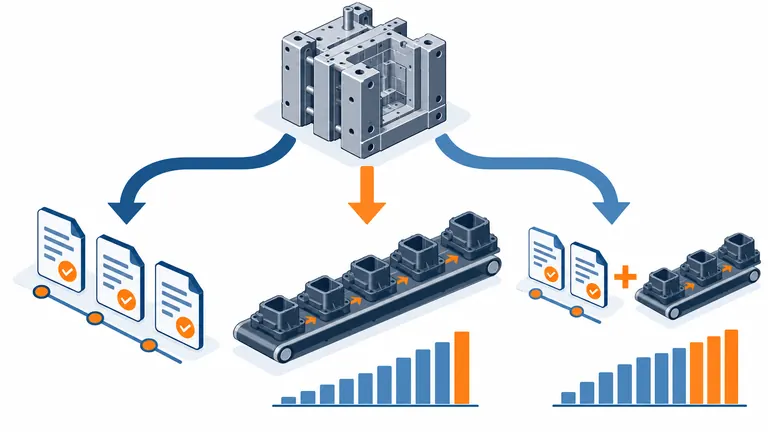
An automotive molded-part quote can look inexpensive because the mold is billed separately—or expensive because tooling is embedded in every part. Comparing only the displayed piece price can therefore reward the wrong proposal. The buyer needs to separate what is being purchased, how tooling is recovered, and what happens if actual volume differs from the forecast.
The practical answer is to compare every proposal on two views: a cash-flow view that shows when tooling and validation payments occur, and a unit-economics view that spreads only the agreed recoverable tooling amount over a stated quantity. The denominator, ownership terms, change rules, and end-of-program treatment must be explicit. Amortization is a commercial payment method; it does not by itself define mold ownership or acceptance.
Start with three separate cost buckets
The first decision is not the amortization period. It is deciding which costs are genuinely part of the mold investment, which belong to launch, and which recur with every shipment. If those categories are blended, a low “tooling” figure may simply have moved work into the piece price or a later charge.
Ask the supplier to divide the quotation into tooling, one-time launch, and recurring production. Tooling normally describes the durable production asset and its specified accessories. Launch costs may include trials, inspection programming, sample preparation, packaging development, or customer-specific submissions. Recurring price covers material, conversion, routine inspection, secondary work, packaging, and the agreed logistics boundary. The exact allocation is negotiable, but it must be consistent across suppliers.
The tooling line should identify what the quoted asset includes: mold base, cavities and cores, slides or lifters, hot-runner equipment, sensors, connectors, lifting and transport provisions, initial spare components, and the documentation package. Where a family of parts requires more than one tool, map each part number to the relevant mold. Where the customer supplies a hot runner, standard component, or existing insert, record that exclusion rather than assuming it is included.
Launch work deserves its own line because it may not scale with production quantity. A dimensional layout, fixture, capability study, or customer submission can be required whether the first release is 5,000 parts or 100,000. The AIAG quality core tools distinguish product-quality planning, control plans, PPAP, measurement-system analysis, and statistical process control; a quotation should identify which requested deliverables are included instead of using “PPAP” as an undefined package.
Finally, define the recurring price at one controlled revision, resin grade, color, annual volume, order quantity, cavity plan, inspection scope, packaging specification, and delivery term. This prevents amortization from hiding a change in production assumptions. The related guide on automotive molded-part pricing explains the recurring cost model; the present decision is how the non-recurring mold investment is funded and recovered.
Choose a recovery model that matches the program risk
There are three common commercial structures: the customer pays the tooling investment directly, the supplier amortizes an agreed amount into the part price, or the parties use a hybrid. None is automatically best. The right model depends on cash timing, forecast confidence, asset control, supplier financing, and the consequences of an early transfer or program cancellation.
With direct payment, the purchase order normally links installments to evidence such as design release, tool completion, trial samples, and acceptance. The part price then excludes the agreed tool recovery amount. This structure makes recurring economics easier to see, but the buyer should still resolve ownership, identification, access, maintenance, and transfer rights in the applicable contract. Payment is not the same as technical acceptance, and this article does not provide a legal conclusion.
With per-part amortization, an agreed recoverable amount is added to each accepted part until a stated quantity or value is reached. The supplier is effectively financing some cash outlay and may price that financing and volume risk. The parties must define whether amortization applies to shipped pieces, invoiced pieces, or accepted pieces; whether scrap, samples, and service parts count; how credits appear after recovery; and how the remaining balance is calculated. A piece-price reduction after the recovery point should be visible rather than left as an expectation.
A hybrid can pay part of the mold at launch and recover the remainder through production. It may reduce both the buyer’s initial cash requirement and the supplier’s exposure. However, it adds reconciliation work. One named ledger should show opening balance, qualifying quantity, recovery per unit, credits, changes, and remaining balance. Finance, purchasing, and the supplier should all use the same version.
Do not infer ownership from the funding model. Resolve ownership and transfer questions separately using the project’s governing documents and the mold ownership questions. Also separate maintenance and engineering changes from the original investment. Otherwise, a normal wear repair or customer design change can silently restart an undefined amortization stream.
Build the denominator from an executable volume case
The denominator controls the apparent amortization per part. A lifetime forecast may produce a small surcharge, but it is unsafe if the program could be resourced, redesigned, cancelled, or transferred before that volume is purchased. Use a volume case that purchasing, program management, and operations can explain and monitor.
Start with the latest program demand by year, not a single lifetime total. Identify launch ramp, peak demand, phase-out, service demand, and the firm-versus-forecast status of each period. Then test whether the proposed mold and production cell can supply that profile using acceptable parts, planned operating time, changeovers, maintenance, and downstream operations. A mathematical forecast is not a purchase commitment, and nominal cavity output is not demonstrated capacity.
The buyer should review at least three scenarios: approved plan, lower-volume case, and higher-volume case. The lower case tests unrecovered balance and cash exposure. The higher case tests capacity, a possible early recovery date, and whether the piece price falls automatically after recovery. If multiple part numbers share a mold, define the mix and allocation rule. Allocating the entire tool to the highest-volume part may distort sourcing decisions for the lower-volume parts.
Illustrative example—hypothetical, not an AutoMoldingPro quotation. Assume the agreed recoverable mold investment is USD 120,000 and the parties choose 600,000 accepted shipped parts as the denominator. The nominal recovery is USD 0.20 per part:
USD 120,000 ÷ 600,000 accepted parts = USD 0.20 per part
If only 360,000 qualifying parts are purchased, USD 72,000 has been recovered and USD 48,000 remains before considering any separately agreed financing, cancellation, or change provisions. If 600,000 are purchased earlier than forecast, the surcharge should stop or be credited according to the written mechanism. This arithmetic is simple; the difficult work is defining “qualifying part,” the authoritative quantity record, and the action at each scenario.
Do not add duties, taxes, financing, tooling maintenance, or validation changes to this example unless the quotation says they are part of the recoverable amount. A transparent model can contain those items, but mixing them after award prevents a meaningful comparison.
Use a two-view quotation comparison
A useful comparison keeps cash timing and normalized economics side by side. First compare actual invoices expected at each milestone. Then calculate an analytical unit cost at one common volume. The analytical figure is for decision-making; it should not replace the supplier’s contractual price schedule.
| Comparison item | Supplier proposal | Normalized buyer view | Evidence to request |
|---|---|---|---|
| Durable tooling scope | Included/excluded items | Same mold and accessory boundary | Tool specification, BOM, design responsibility |
| Launch and validation | One-time or bundled | Same deliverable list | Trial plan, inspection and submission scope |
| Recovery method | Direct, per-part, hybrid | Cash by milestone and recovery per accepted part | Payment schedule and amortization ledger rules |
| Volume basis | Forecast or committed quantity | Approved, low, and high cases | Demand profile and assumption date |
| Post-recovery price | Stated or unstated | Recurring price without recovery surcharge | Written price step or credit method |
| Early transfer/cancellation | Balance rule | Exposure under a named scenario | Applicable commercial terms and balance statement |
| Ownership and access | Sometimes implied | Reviewed separately | Asset identification and transfer documents |
| Maintenance/changes | Included, excluded, or capped | Separate lifecycle allowance | Maintenance plan and change quotation method |
Use the table in a cross-functional review. Engineering confirms that tooling scopes are technically equivalent. Quality confirms deliverables and approval boundaries. Operations checks capacity assumptions. Purchasing and finance compare cash and balance exposure. Legal or authorized commercial personnel review ownership and termination terms. A single “total cost” cell cannot replace those decisions.
When suppliers propose different tool architectures, normalize architecture before normalizing amortization. A one-cavity tool and a two-cavity tool are not interchangeable investments. Use the single-, multi-cavity, and family-mold comparison to resolve capacity and mix before spreading cost across parts.
Close the recovery account without losing asset control
The amortization arrangement needs an operating process after sourcing. Without one, purchasing may continue paying a recovered surcharge, the supplier may use a different quantity record, or a transfer may begin without an agreed balance and document package.
Assign an owner for a periodic statement. It should identify the mold, customer asset number if applicable, original recoverable amount, approved additions or credits, qualifying quantity during the period, cumulative quantity, recovery per unit, recovered value, and remaining balance. Reconcile it to invoices and shipment records. Investigate returns, replacements, samples, and scrap according to the agreed counting rule.
Engineering changes require a new decision, not an automatic addition to the old balance. The change quotation should separate product-design change, correction of supplier nonconformance, wear restoration, and optional improvement. It should show affected tool components, new trials, inspection, customer submission work, and the proposed payment method. The engineering-change cost guide addresses that scope in detail.
At recovery completion, issue a written closeout or price change using the authorized commercial process. Confirm the new recurring unit price, the effective shipment or invoice date, any final reconciliation, and whether service-part pricing follows a different rule. Separately verify asset marking, current mold drawings, maintenance history, spare inventory, and transfer readiness. These records matter even if the tool remains at the current molder for the full program.
Before requesting a revised quotation, prepare the controlled part data, mold architecture, annual and lifetime volume scenarios, validation deliverables, delivery term, ownership requirements, and preferred funding model. Ask each supplier to return the same cost buckets and recovery fields. That makes tooling amortization a visible financing choice instead of a hidden reason why two piece prices cannot be compared.
Conclusion
Separate durable tooling, launch work, and recurring production first. Then compare direct payment, per-part recovery, and hybrid funding against the same volume scenarios. Do not release the commercial model until the recovery ledger, post-recovery price, change treatment, and ownership/transfer documents all have named owners.