
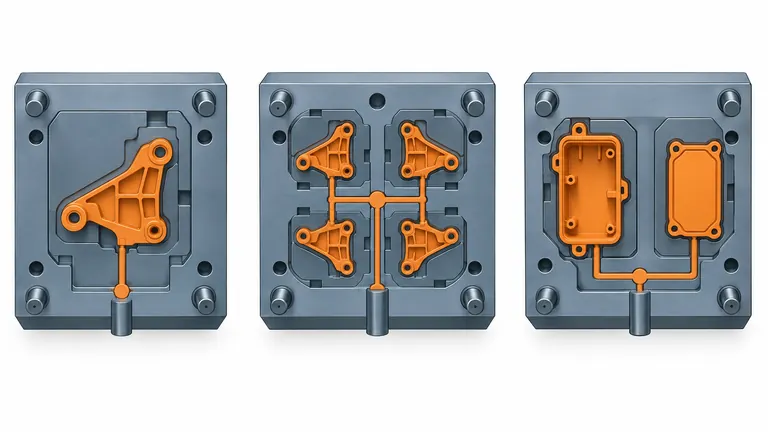
Conceptual illustration; not to scale.
Choosing cavities by annual volume alone can create the wrong tool. A higher-cavity mold may reduce press time per part but increase capital, qualification effort, maintenance exposure, and cavity-to-cavity variation. A family mold may share a mold base yet force different parts to run in a ratio that does not match demand.
Choose the mold architecture by comparing total program demand, peak capacity, part mix, resin and color compatibility, process balance, change risk, qualification burden, maintenance strategy, and the cost of lost output. The preferred option is the least risky way to produce acceptable parts across the program—not simply the lowest mold price or the most cavities.
Define the three architectures before comparing cost
A single-cavity mold produces one part geometry per cycle. A conventional multi-cavity mold produces multiple copies of the same part. A family mold produces two or more different part geometries in one cycle. These definitions matter because each option creates a different relationship between tooling investment, output, inventory, and process control.
Single-cavity tooling usually has fewer cavity inserts, gates, cooling branches, ejectors, and inspection positions. It can be attractive for lower demand, large parts, frequent engineering changes, tight launch timing, or programs where flexibility matters more than machine-hour efficiency. The disadvantage is that one cycle yields one part, and a tool stoppage removes all output unless another approved source exists.
A multi-cavity tool increases parts per cycle, but the mold may need a larger base, more machining, more hot-runner drops or runner volume, additional cooling and ejection, a larger press, and more cavity-specific measurement. Output improves only when cavities fill, pack, cool, eject, and remain available within an acceptable common process window. Husky’s discussion of multi-cavity system balance explains that balance influences the usable process window; geometric duplication alone does not guarantee identical cavity behavior.
A family mold can share a mold base and cycle for related components. It is most credible when the parts use the same resin and color, need a stable production ratio, fit one press and thermal process, and can be gated and cooled without unacceptable imbalance. The economic penalty appears when demand ratios diverge, one part changes, one cavity stops, or one component needs a different material or appearance condition. Every shot may then create unwanted inventory or scrap for the other family members.
Compare capacity and payback using good parts, not nominal cavities
The first calculation is required annual shots: annual good parts ÷ effective good parts per shot ÷ effective yield. Convert that demand into machine hours using a realistic production cycle, then add planned setup, maintenance, validation, and contingency time. Repeat the calculation for peak weekly or daily releases; annual capacity can look sufficient while the release pattern exceeds the available window.
Illustrative example: assume a component is needed in a stable annual quantity. A one-cavity option has the lowest tool investment but consumes the most machine hours. A four-cavity option has a higher tool and qualification cost but may reduce conversion hours. Do not divide unit conversion cost by four mechanically. The four-cavity mold may use a larger machine, a longer cycle, more complex automation, and more inspection. Effective output may be three parts per shot during a cavity repair. The correct comparison calculates each scenario from its own cell rate, cycle, effective cavities, uptime, and good-part yield.
Use incremental payback: compare the additional tooling and launch investment with the recurring savings per acceptable part at the expected volume. Then test the result at lower demand, delayed launch, shorter program life, resin price changes, and a cavity-out event. A short payback under one optimistic forecast is not enough. If the buyer has no binding volume commitment, the commercial treatment of unused capacity and unamortized tooling must be explicit.
Machine compatibility can also change the result. More cavities increase shot volume, projected area, mold dimensions, cooling demand, and possibly clamp or injection requirements. A larger press rate can offset some throughput gain. Verify tie-bar spacing, daylight, mold height, shot capacity, plasticizing rate, injection pressure, ejector interface, utilities, robot access, and handling. The existing export mold machine compatibility checklist provides a detailed interface review when the destination press is fixed.
Test family molds against ratio, change, and outage risk
Family mold economics depend on a synchronized need for all components. Write the planned consumption ratio next to the mold output ratio. If one shot produces one left cover and one right cover, but field demand or scrap creates a 60:40 requirement, inventory will diverge. If the family tool makes a housing, lid, and lever used one-to-one, verify that assembly scrap, service-part demand, color variants, and engineering changes will not break the ratio.
Check process compatibility. Different geometries can require different fill rates, pack pressures, gate sizes, cooling times, ejection forces, and appearance controls. The cycle is usually governed by the slowest or hottest component. Runner or hot-runner balance must deliver acceptable conditions to every cavity. A process adjustment that corrects sink on the thick housing could flash a thin lid. A gate that is suitable for a hidden bracket may leave an unacceptable vestige on a visible cover.
Change exposure is equally important. With separate tools, one component can change while the others continue. In a family mold, modifying one cavity may require removing the shared tool from production. A design revision can disturb cooling, balance, or maintenance access even when other cavities are nominally unchanged. Define whether unused cavities can be safely blocked, how the runner will behave, and whether resulting parts require requalification.
Outage consequences should be modeled. If one cavity is damaged, can the tool run the remaining parts without compromising balance or creating excess inventory? Is a replaceable insert available? How quickly can a cavity be isolated and restored? A family mold may concentrate several components in one asset, so one maintenance event can stop an entire assembly. That concentration can be acceptable when the tool is robust and spare strategy is strong; it should not be hidden by the initial mold-base saving.
Include qualification, maintenance, and traceability in the investment
Each cavity is a production source that can have its own dimensional bias, gate condition, cooling behavior, and wear. The validation plan should identify parts by cavity and confirm that all cavities meet drawing, appearance, assembly, and functional requirements under the approved process. A pooled dimensional average can hide one cavity at the edge of tolerance.
For multi-cavity molds, define a balance study appropriate to the material, runner, gate, and process. Husky notes there is no single universally accepted balance expectation; the method and acceptance criteria should be agreed for the application. Verify not only an initial short-shot pattern but also cavity-specific part mass, critical dimensions, appearance, and the relationship between first-to-fill and last-to-fill cavities. If one cavity is later repaired or replaced, define the evidence required before it returns to production.
Maintenance cost grows with components and complexity, but not necessarily in a linear formula. Compare hot-runner service, valve pins, heaters, thermocouples, slides, lifters, ejectors, cooling circuits, seals, spare inserts, and cleaning access. A multi-cavity tool can still be the lowest total-cost option when designed for service. Conversely, a low-cost high-cavity tool with inaccessible wear items may lose its expected production advantage.
Traceability should match the risk. Cavity marks help connect measurements and defects to the source. Family molds also need clear part identity and downstream counting so that mixed parts do not create packing errors. Decide whether parts remain segregated by cavity, pooled after validation, or sampled by a rotating plan. AIAG’s quality core tools connect process planning, measurement-system analysis, control plans, and production approval; the customer still defines the applicable evidence and acceptance criteria.
Use a decision matrix instead of a volume rule
| Decision factor | Single cavity | Multiple identical cavities | Family mold |
|---|---|---|---|
| Tool investment | Usually lowest architecture complexity | Higher with added cavities and systems | Can share base and systems across different parts |
| Output | One part per cycle | Several identical parts per cycle | A fixed mix of different parts per cycle |
| Demand flexibility | High for one part | High for one part, subject to cavity state | Low when part-demand ratios diverge |
| Process balance | Simplest | Cavity-to-cavity balance required | Different geometries and thermal needs must coexist |
| Change impact | Limited to one part/tool | One design affects all duplicate cavities | One component change may stop the complete family |
| Outage concentration | One part stops | Output may continue with an approved cavity-out strategy | Several assembly components may stop together |
| Qualification | One cavity/source | Every cavity and pooled process | Every different part and interaction |
Complete the matrix with actual quotations and capacity assumptions. Include tool price, gauges, automation, launch samples, validation, press rate, cycle, effective cavities, yield, maintenance, spare strategy, inventory imbalance, and expected engineering changes. Keep hot-runner selection as a separate design decision; it affects waste, cycle, balance, service, and investment but does not by itself decide cavity architecture. The existing hot-runner versus cold-runner guide covers that trade-off.
Before asking a supplier to recommend cavitation, send annual and peak demand, program life, release pattern, left/right or assembly ratios, resin and color variants, expected changes, part geometry, critical characteristics, destination presses, and contingency expectations. AutoMoldingPro can evaluate these inputs through the request-a-quote page without assuming that a higher cavity count is universally better.