
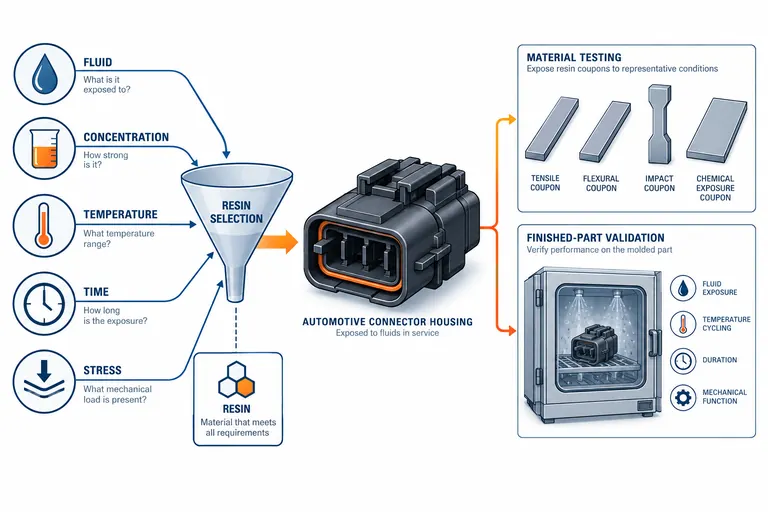
A material described as “chemical resistant” can still fail when the fluid, concentration, temperature, contact time, stress, and molded condition differ from the test behind that description. Automotive parts also encounter mixtures, aged fluids, cleaners, splash cycles, and assembled loads that simple compatibility charts may not represent.
Select resin by defining the exposure first, screening exact grades with condition-matched evidence, and validating production-molded parts in the relevant assembly state. A ranking of polymer families is not a substitute for a requirements matrix, because chemical resistance is a relationship between material, medium, environment, geometry, stress, and acceptance criterion.
Build an exposure definition before requesting material options
Name the fluid precisely. “Oil,” “fuel,” “coolant,” and “cleaner” are categories, not test media. Record specification, formulation or supplier, concentration, additives, contamination, and expected aging. For service mixtures such as glycol and water, define the ratio. If regional fuels, washer fluids, disinfectants, sunscreen, or aftermarket cleaners matter, identify them rather than asking for universal resistance.
Describe contact mode and replenishment: continuous immersion, internal flow, vapor, splash, drip, wipe, condensation, or accidental service exposure. Include temperature, pressure, duration, cycle count, wet/dry sequence, and whether the fluid is refreshed. Evaporation can concentrate a residue; repeated wetting can produce a different outcome from one long immersion.
Add mechanical and electrical state. Is the part under screw preload, snap strain, internal pressure, vibration, cable pull, bending, or residual molding stress? Does it have metal inserts, weld lines, sharp radii, seals, adhesive, paint, labels, or conductive terminals? Stress can turn mild swelling or surface attack into cracking, leakage, loss of retention, or insulation failure.
Define what “pass” means. Possible criteria include no cracking, controlled mass or dimension change, retained tensile or impact property, maintained torque, seal integrity, electrical function, color/gloss retention, marking legibility, and successful assembly. The responsible customer engineer should identify the governing specification and revision. The material supplier can provide data, but it cannot decide the vehicle-level requirement.
Use compatibility data as a screen, with its test conditions attached
Producer chemical-resistance tables can eliminate poor candidates and expose missing data. They are most useful when they state exact grade, specimen, conditioning, fluid, concentration, temperature, duration, and measured property. A green or “resistant” rating without those conditions is only a clue.
Celanese’s polyester technical manual demonstrates why conditions matter. Its tables report property, weight, and diameter changes for specific reinforced PBT materials over defined times and temperatures; results for automotive fluids change markedly with exposure temperature and duration (Celanese Polyester Technical Manual). Those values apply to the identified materials and specimens, not every PBT grade or molded geometry.
Compare exact grades using this screen:
| Evidence field | Minimum detail | Why it matters |
|---|---|---|
| material identity | producer, full grade, reinforcement, color/additives | family names hide formulation differences |
| specimen | molded or machined, thickness, flow direction, conditioning | diffusion and stress depend on specimen state |
| medium | name, specification, concentration and age | commercial fluids and mixtures differ |
| exposure | temperature, duration, pressure, replenishment and cycling | degradation rates are condition-dependent |
| mechanical state | unstressed, bent, loaded, assembled or pressurized | environmental stress cracking can be load-driven |
| response | appearance, mass, dimensions, retained property or function | “no visual change” may not protect the real requirement |
Use database results to find candidate grades, then return to current producer documents and direct technical support. If evidence is not available at the required condition, do not interpolate aggressively from a lower temperature or shorter duration. Create a test gap.
Consider absorption, reaction, stress cracking, and permeation separately
Chemical exposure does not produce one universal failure mode. Absorption may swell a polymer, plasticize it, shift dimensions, or reduce stiffness. Extraction can remove additives or colorants. Hydrolysis can cut molecular chains in susceptible polymers under hot wet conditions. Oxidation and UV can interact with chemicals. Solvents or cleaners may trigger environmental stress cracking at molded-in stress, a fastener boss, or a snap root.
Permeation matters for fluid and vapor barriers even when the surface looks unchanged. Leakage can occur through the bulk material, along a weld line, around an insert, at a seal interface, or through a cable jacket/overmold boundary. A coupon immersion result does not establish a complete housing’s seal performance.
Geometry and process influence susceptibility. Thick walls slow diffusion but can contain residual stress and sink. Sharp radii, excessive packing, cold flow, poor drying, degradation, contamination, and weld lines can create weak sites. Fiber-filled grades can expose fibers or create anisotropic paths. Painting or plating adds its own adhesion and cracking interfaces.
The selection team should ask what mechanism is plausible for each function. A washer-fluid reservoir bracket may be dominated by occasional splash and mechanical load; a coolant connector by hot-fluid contact, pressure, hydrolysis, and seal stability; an interior switch bezel by cleaner, sunscreen, surface appearance, and molded stress. This mechanism map determines which evidence and tests matter.
Design a staged validation program instead of one severe soak
Begin with material-level screening under conditions close enough to rank candidates. Use controlled specimens from the exact grade and color. Measure the properties linked to function, not only mass change. If an assembled boss must retain torque, tensile-bar retention alone is not a direct acceptance measure.
Next test production-representative molded features. Include weld lines, thin sections, inserts, texture, and the actual process window. Identify lots and cavities, record drying and melt condition, and condition parts before exposure as specified. Compare unexposed controls with exposed samples using the same measurement system.
Finally test the assembly in the intended sequence. Apply preload, pressure, electrical operation, vibration, thermal cycling, or bend load where required. Test sequence can reveal interactions: thermal cycling may open an interface before fluid exposure; chemical exposure may soften a strain-relief area before vibration; hot coolant may affect both resin and seal compression.
For a connector housing exposed to a glycol mixture, a defensible plan could compare exact-grade coupon evidence, mold housing samples from representative cavities, assemble the approved seals and terminals, condition samples, run the customer-defined hot-fluid and thermal sequence, then recheck leakage, terminal position, latch function, dimensions, and visible cracking. Every condition and limit comes from the released requirement or an approved test plan, not from a generic internet chart.
Define failure handling before the test. Preserve failed samples, lot and cavity identity, photographs, measurement data, and fracture location. Decide whether the next action is material change, geometry correction, process change, interface redesign, or a revised exposure assumption approved by the customer.
Compare candidate materials without creating a false winner score
A weighted matrix can organize judgment, but a high total cannot offset failure of a mandatory criterion. Use pass/fail gates for customer specifications, safety-related functions, flammability, declarations, and critical sealing. Apply weighted tradeoffs only after mandatory gates are met.
| Gate | Candidate A | Candidate B | Evidence owner | Open action |
|---|---|---|---|---|
| exact grade and source defined | pass/open | pass/open | purchasing/material supplier | obtain current documents |
| required fluid conditions represented | pass/fail/open | pass/fail/open | materials engineer | close data or test gap |
| molding process feasible | pass/open | pass/open | molder/toolmaker | trial process window |
| dimensional and assembly function | pending | pending | product engineering | molded-part evaluation |
| environmental sequence | pending | pending | customer/laboratory | approve plan and execute |
| declarations and change approval | open | open | supplier quality/customer | confirm submission route |
Include commercial consequences: resin price, drying, scrap, cycle, tool changes, inspection, external testing, minimum purchase, shelf life, and change-control burden. A material with strong resistance data but no approved supply path may not be the lowest-risk production choice. A cheaper grade that needs a coating or thicker wall may raise total cost.
Put exposure and validation inputs into the RFQ
Send the CAD, drawing, material specification, exposure matrix, component location, operating and storage temperatures, loads, mating materials, seal details, surface treatment, annual demand, regulatory declarations, customer test methods, acceptance criteria, sample quantities, and PPAP/change requirements. Identify who supplies fluids, fixtures, mating parts, and laboratory services.
Require suppliers to state exact grades, production locations, evidence reviewed, unsupported conditions, process assumptions, tool implications, proposed sample plan, and exclusions. Ask whether quoted testing is in-house or external and what report will be delivered. Do not accept a statement such as “nylon resists oil” as closure.
Use the automotive RFQ checklist for baseline project information. For a chemical-duty part, attach the exposure and acceptance tables above so suppliers quote the same problem.
Conclusion
Chemical resistance becomes an engineering decision only when fluid, concentration, temperature, time, stress, part condition, and acceptance are defined. Send AutoMoldingPro the CAD, drawing, candidate grade, exposure matrix, annual volume, assembly details, and required validation through the contact page for a molding feasibility review.