
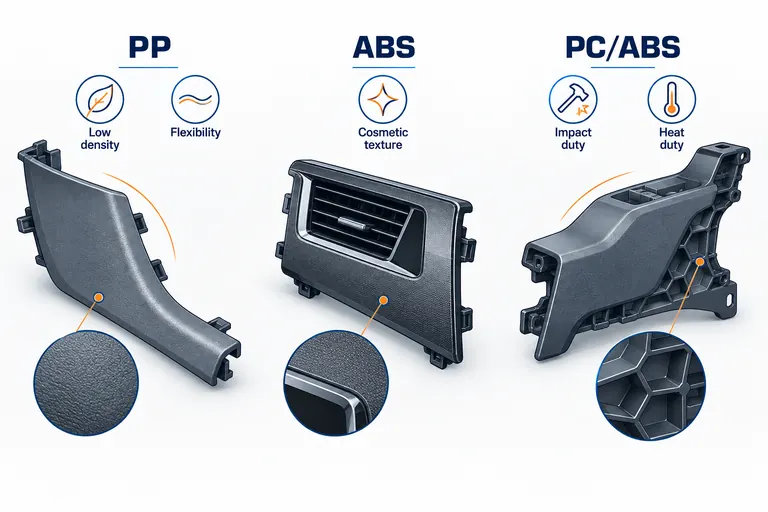
Choosing an interior resin by family name alone creates false confidence. PP, ABS, and PC/ABS can all appear in cabin components, yet the grade, part geometry, finish, assembly load, temperature exposure, emissions requirement, and customer specification determine whether any one of them is suitable. This expanded version fixes that gap with grade-specific datasheet values from named producers, and the rules for reading them.
Start from the part’s requirement record, not from a favourite polymer. Compare exact grades on the same test methods at the same conditions, and let the eliminations do the choosing: a 20% talc-filled PP such as SABIC PPcompound 37T1020 gives the stiffest panel at the lowest density, a general-purpose ABS such as INEOS Styrolution Novodur P2H-AT gives the best surface and the most forgiving tool behaviour, and a PC/ABS blend such as Covestro Bayblend T65 XF gives the widest heat and cold-impact margin. Each statement is true only for the named grade: a different grade inside the same family can reverse every ranking in this article.
This article is the PP/ABS/PC-ABS interior framework. For fluids and chemicals, see Resin Selection for Automotive Parts Exposed to Fluids and Chemicals; for under-hood nylon, see PA6 and PA66 for Under-Hood Parts: Grade, Moisture, and Temperature Questions; for talc-filled PP, see Talc-Filled PP for Automotive Panels: Stiffness, Warpage and Surface Trade-Offs; for an unavailable specified grade, see Specified Automotive Resin Unavailable: What Must Be Approved Before Substitution?; and for confirming the exact grade against an OEM specification, see Automotive OEM Material Specifications: Confirming the Exact Grade and Approval Scope.
What must the requirement record contain before any family is compared?
A material decision made from a part name alone is a guess dressed as a specification. A door carrier, a textured decorative bezel, a hidden HVAC duct, a screw boss around an electronic module, and a trim clip do not ask the material to do the same work, and the same family name covers grades that behave very differently. Identify the visible surfaces, load paths, attachment method, neighbouring materials, cabin zone, abuse modes, and customer substance requirements before any datasheet is opened.
Write the requirement record first, as measurable values with their test conditions, and treat anything that cannot be written that way as an open question — not as a property of the polymer family.
Record the highest and lowest part temperatures with duration at temperature, not a single "service temperature": a sun-soaked upper trim panel and a shaded lower panel can differ by tens of degrees, and a grade that survives a short peak may creep under a sustained load at a lower temperature. Record impact as location, direction, temperature, and energy or test method — "good impact" is not a requirement. Record allowed permanent deformation, datums, texture, gloss and colour controls, scratch expectations, cleaning agents, UV exposure, odour or VOC rules, and flammability requirements.
A console side panel may need a grained surface and clip retention but carry little load; an instrument-panel support may prioritise stiffness, impact, creep, and dimensional control while hidden. Also define the condition in which acceptance applies.
What do grade-specific datasheet values actually show — and how do you read them without being misled?
The table below is the decision core of this article. It compares one named grade per family: SABIC PPcompound 37T1020, a 20% talc-filled PP copolymer designated by SABIC as an automotive grade for interior parts such as column cladding and door panels; INEOS Styrolution Novodur P2H-AT, a general-purpose, high-flow ABS; and Covestro Bayblend T65 XF, a high-flow PC/ABS blend. These are example grades, not recommendations.
| Property (method) | PP — SABIC PPcompound 37T1020 (20% talc copolymer) | ABS — INEOS Styrolution Novodur P2H-AT (general-purpose) | PC/ABS — Covestro Bayblend T65 XF (high-flow blend) |
|---|---|---|---|
| Density (ISO 1183) | 1.04 g/cm³ | 1.05 g/cm³ | 1.13 g/cm³ |
| Melt flow (ISO 1133) | MFR 13 g/10 min (230 °C / 2.16 kg) | MVR 37 cm³/10 min (220 °C / 10 kg) | MVR 18 cm³/10 min (260 °C / 5 kg) |
| Tensile modulus (ISO 527) | 2,100 MPa | 2,500 MPa | 2,350 MPa |
| Tensile stress at yield (ISO 527) | 28 MPa | 44 MPa | 54 MPa |
| Flexural modulus (ISO 178) | 2,650 MPa | 2,400 MPa | 2,350 MPa |
| Flexural strength (ISO 178) | Not listed on this sheet | 70 MPa | 84 MPa |
| Notched Izod impact, 23 °C (ISO 180/1A) | 5.7 kJ/m² | 16 kJ/m² | 48 kJ/m² |
| Notched impact, cold | 3.0 kJ/m² at −20 °C (Izod, ISO 180/1A) | 7 kJ/m² at −30 °C (Izod, ISO 180/1A) | 35 kJ/m² at −30 °C (Izod, ISO 180/1A); 36 kJ/m² (Charpy, ISO 179/1eA) |
| HDT, 1.8 MPa (ISO 75) | Not published on this sheet | 93 °C (annealed) | 102 °C |
| HDT, 0.45 MPa (ISO 75) | 110 °C | 97 °C | 122 °C |
| Vicat softening (ISO 306) | Not published on this sheet | 98 °C (B/50) | 118 °C (B/50); 120 °C (B/120) |
| Mould shrinkage (ISO 294-4 unless noted) | 1% (SABIC method, 65 × 65 × 3.2 mm plaque, 24 h) | 0.4–0.6% | 0.50–0.70% |
| UL 94 rating | Not published on this sheet | HB at 1.6 mm | HB at 0.85 mm |
| FMVSS 302 burn rate (ISO 3795) | Not published on this sheet | 60 mm/min at 2.0 mm | Not published on this sheet |
| Water absorption | Not published on this sheet | Not published on this sheet | 0.7% saturation; 0.2% at 23 °C / 50% r.h. (ISO 62) |
| Drying before moulding | No drying instruction on this sheet — confirm with the producer | 80 °C, 2–4 h | 95–110 °C, 4 h dry air; moisture ≤ 0.02% |
| Melt / mould temperature (ISO 294) | Not published on this sheet — confirm with the producer | Melt 230–260 °C; mould 60–80 °C | Melt 240–270 °C (standard 260 °C); mould 70–90 °C |
Sources: SABIC PPcompound 37T1020 technical data sheet, revision 20260316; INEOS Styrolution Novodur P2H-AT CAMPUS datasheet, edition 03.12.2007; Covestro Bayblend T65 XF technical data sheet, version 2026-10-09. All values are the producers’ typical values, not specifications — see the reading rules below. Full links are in the References.
Read the table as three single grades, not three families — and never rank two numbers that were measured differently.
Four reading rules prevent most mistakes. First, compare only values measured by the same method at the same condition. The PP grade’s cold impact is reported at −20 °C while the ABS and PC/ABS grades report at −30 °C, so the PP number cannot be ranked against the other two; ask the producer for the PP grade’s −30 °C value first. Second, HDT is not a service-temperature limit: it is the temperature at which a standard bar deflects under a stated load. The PP sheet publishes HDT only at 0.45 MPa (110 °C) and gives no 1.8 MPa value, while the ABS value at 1.8 MPa (93 °C) is for annealed specimens. For HDT, glass transition, and continuous-use temperature, see HDT, Glass Transition and Continuous-Use Temperature: Reading Automotive Resin Data. Third, datasheet values are typical values, not specifications: the lot certificate of analysis and the customer’s material specification govern. Fourth, check the revision — the Novodur values above come from the 2007 CAMPUS edition, and later revisions list slightly different values. Name both revisions in the RFQ.
The most important lesson is how wide a single family is. SABIC PPcompound 9180, an elastomer-modified, 20% mineral-filled PP also designated for automotive interiors, has a flexural modulus of 2,050 MPa (against 2,650 MPa for 37T1020) but notched Izod impact of 25 kJ/m² at 23 °C, 10 at 0 °C, and 5 at −20 °C (against 5.7, 3.5, and 3.0) ; the impact-modified grade trades stiffness for impact. "PP" alone tells the buyer almost nothing; the grade, the filler, and the modifier do.
Where a cell says "not published on this sheet", that is a gap to close, not a zero. If the customer requires a flammability result, request the test report for the exact grade, colour, and thickness. For UL 94 checks by grade, thickness, and colour, see UL 94 Ratings for Automotive Resins: Checking Grade, Thickness and Colour.
Which family wins on heat, impact, stiffness, and weight — and where does each lose?
On stiffness per unit mass, the talc-filled PP example leads; on cold impact and heat under load, the PC/ABS example leads by a wide margin; on the balance of stiffness, surface, and processability at moderate temperature, the ABS example sits in the middle.
Heat eliminates candidates fastest. The PC/ABS example’s HDT is 102 °C at 1.8 MPa (against 93 °C for ABS) and 122 °C at 0.45 MPa (against 110 °C for PP and 97 °C for ABS), and its Vicat softening temperature (120 °C at B/120) is the highest. That makes PC/ABS the default shortlist for sun-exposed trim and parts that must hold position while hot. The pass line must be written as a temperature, a load, a duration, and a test method.
Impact is where the families separate most sharply, and where the table most easily misleads. At room temperature the notched Izod values run 5.7 (PP), 16 (ABS), and 48 kJ/m² (PC/ABS); cold, they fall to 3.0 kJ/m² at −20 °C, 7 kJ/m² at −30 °C, and 35 kJ/m² at −30 °C respectively. The PP number belongs to a stiff talc-filled grade; the impact-modified PP 9180 reaches 25 kJ/m² at 23 °C, so a PP part that must survive a cold clip-snap needs a different PP grade — and that grade gives back stiffness. A single notched-bar number does not predict part behaviour — validate on parts, not bars.
On stiffness, the talc-filled PP example has the highest flexural modulus in the table (2,650 MPa) at the lowest density (1.04 g/cm³), which is why talc-filled PP dominates large, lightly loaded panels. The ABS and PC/ABS examples are close on stiffness (2,400 and 2,350 MPa) but the PC/ABS example carries the higher yield stress (54 MPa against 44 MPa) and flexural strength (84 MPa against 70 MPa), so it holds a loaded feature with more margin before it yields. For long-term load, ask for creep data, which only the ABS sheet publishes.
On weight, the densities are 1.04 (PP), 1.05 (ABS), and 1.13 g/cm³ (PC/ABS). The talc filler has already cost PP most of its unfilled weight advantage, and the PC/ABS part will be roughly 9% heavier than the same volume in the PP example. Where mass is scored, calculate it from the actual grade densities and the wall thicknesses each grade needs.
Which family wins on appearance, finishing, and cabin compliance?
ABS is the easiest family to finish; PC/ABS is close behind it and the most forgiving of the three when a part must be both good-looking and hot; talc-filled PP is the hardest to finish well and should be specified for visible surfaces only with a demonstrated grain, colour, and scratch package — never on the assumption that "PP is fine for trim".
Surface quality starts with the moulded surface itself. ABS is the reference family for grained and high-gloss interior surfaces: it replicates texture cleanly, holds colour uniformly, and shows fewer flow marks than PP on a large visible panel. PC/ABS is close, with good surface replication and a tougher substrate under the finish Talc-filled PP can produce an acceptable grained surface, but filler raises the risk of flow lines, tiger striping, and gloss variation, and a scratch-resistant package must be demonstrated on plaques. For acceptance standards, see Cosmetic Acceptance for Automotive Trim: Colour, Gloss and Grain and What Should Engineers Know About Injection Molding for Automotive Dashboard Panel Components?.
Secondary operations follow the same pattern: ABS accepts paint and chrome plating directly, PC/ABS paints well but needs its paint system and cleaner exposure checked on the exact grade, and PP needs flame or plasma treatment before paint or print will adhere — a painted PP part without a treatment step is an incomplete specification.
Cabin compliance is a documentation decision as much as a material one. Flammability for US interiors is governed by FMVSS 302 (49 CFR 571.302): material in the occupant compartment must not burn, nor transmit a flame front, at more than 102 mm per minute, tested on a 102 mm × 356 mm specimen conditioned for 24 hours at 21 °C and 50% relative humidity. The ABS example’s datasheet reports 60 mm/min at 2.0 mm by ISO 3795 — inside the limit, for that grade at that thickness. The PP and PC/ABS sheets publish no FMVSS 302 result, which does not mean they fail; the buyer must obtain the test report for the exact grade, colour, and thickness. For scope and sampling, see Automotive Interior Flammability Testing: Defining FMVSS 302 Scope and Sample Requirements. Odour, VOC, and fogging are customer-specific (commonly VDA 270, VDA 278, and ISO 6452), measured on the coloured production compound — not on natural pellets. Agree the sampling plan before moulding: see Automotive Interior VOC and Fogging Tests: What to Agree Before Sampling.
What changes in the tool, the process, and the assembly when the family changes?
Changing polymer family can change shrinkage, stiffness, draft, ejection, gate freeze, packing, weld lines, warpage, and surface replication. An existing tool built around ABS dimensions may not produce an acceptable PP part simply because the nominal CAD is unchanged: the PP example shrinks about 1% against 0.4–0.6% for ABS and 0.50–0.70% for PC/ABS, and its shrinkage is anisotropic in a filled grade, so a PP part in an ABS-cut cavity will come out small and distorted.
Price the family change as a tooling and process change, not as a material price difference: shrinkage, drying, mould temperature, and weld-line behaviour are the costs that hide inside a resin swap.
Shrinkage and warpage come first in any conversion review. Filled PP shows flow-direction effects: stiffness, shrinkage, and warpage differ along and across flow, so gate position and cooling decide whether a large flat panel stays flat. The amorphous families (ABS, PC/ABS) shrink less and more uniformly, which is one reason they hold tight interfaces and fine grain more easily. For measurement, see Warpage in Thin-Wall Automotive Interior Panels: Design, Cooling and Measurement.
Processing comes second. PC/ABS demands controlled drying — the Covestro sheet requires 95–110 °C for 4 hours in dry air and moisture at or below 0.02% — and a melt temperature of 240–270 °C with a mould at 70–90 °C; wet PC/ABS moulds with splay, silver streaks, and degraded impact, so a moulder without a verified drying process should not be quoted for it. ABS needs lighter drying (80 °C for 2–4 hours) and runs cooler. Ask the moulder to identify where each candidate needs a different gate, a steel-safe correction, a cooling change, or a process window.
Assembly can reverse an apparent advantage. A low-modulus panel may absorb abuse but allow buzz, squeak, or interface movement; a stiff blend may retain geometry but concentrate snap stress. Assembly details each have grade-specific constraints, and a snap finger designed for ABS stiffness will not behave the same in a talc-filled PP or a PC/ABS at the same geometry. Cleaner compatibility also matters under residual stress: PC/ABS is sensitive to stress cracking from certain cleaners, sunscreens, and solvents, so the exact cleaner list must be tested on stressed, production-intent parts, not on unstressed bars.
Compare total system cost, not material price alone: a PP saving that needs a thicker wall, a bigger rib package, a surface treatment, and a tool rebuild may cost more than the PC/ABS it replaces. Compare proposals on the same scope — see How to Compare Automotive Injection Molding Quotes Beyond Mold Price.
How do you validate the chosen grade so the evidence survives customer approval?
A material is not approved because a trial "looked good". Validation is planned around the actual failure modes: screen material evidence, mould representative parts, then test the assembled part under the conditions it will actually see.
Validate the assembled part, in its defined condition, against the requirement record — with the test method, sample identity, conditioning, and acceptance limit written down before the trial starts.
Start with the paper screen: the current technical data sheet, processing guide, regulatory declarations, colour information, IMDS entry, and the test conditions behind every important value. The PP example carries IMDS ID 16161338. Then mould representative parts and record the resin lot, colourant route, drying, cavity, machine, mould and melt conditions, and any regrind rule. Keep cavity identity on the samples.
Measure the functional datums and interfaces in the defined condition. Run assembly checks for clips, screws, bezels, gaps, flushness, and mating parts, Apply heat ageing, thermal cycling, impact, scratch, cleaner, sunscreen, UV, odour, VOC, and flammability tests only where the design record or customer requirement calls for them — a standard name does not prove the supplier owns that test capability, so establish the laboratory and report format before the trial. If PC/ABS passes the thermal requirement but cracks after the specified cleaner exposure, adjust grade, process, geometry, or exposure requirement.
Release criteria should state which tests apply, sample quantity, lots and cavities, conditioning, measurement method, acceptance limit, and approver. Where the submission is a PPAP, see PPAP for Automotive Molded Parts: Scope and Responsibilities. If two approved grades may run in the same mould, see Can Two Approved Resin Grades Run in the Same Automotive Mould?; if the buyer supplies the resin, see Customer-Supplied Resin for Automotive Molding: Receiving and Control.
Interior Resin Selection Review
| Review area | What to confirm before tool release |
|---|---|
| Requirement record | Part location and cabin zone, visible surfaces, loads, attachment method, temperature profile with duration, impact conditions, appearance and cabin requirements — all as measurable values with test methods |
| Grade, not family | Exact producer, grade, filler/modifier, colour package, and datasheet revision named; "PP", "ABS", or "PC/ABS" alone is not a specification |
| Datasheet comparison | Same test method, same load, same temperature, same specimen condition for every ranked value; gaps ("not published") recorded as open evidence, not filled in by assumption |
| Heat and cold | HDT at the stated load, Vicat, and cold notched impact at the customer’s temperature — with the PP −20 °C vs −30 °C reporting difference resolved before ranking |
| Appearance and finishing | Grain, colour, gloss, scratch, paint/plating/laser-marking route demonstrated on plaques; PP paint route includes its surface treatment |
| Cabin compliance | FMVSS 302 report for the exact grade, colour, and thickness; VOC/fogging/odour method, edition, and limit agreed; UV and ageing package named |
| Tool and process | Shrinkage (PP ≈ 1% vs ABS 0.4–0.6% vs PC/ABS 0.50–0.70% on the example grades), gate, cooling, drying (PC/ABS ≤ 0.02% moisture), and mould-temperature consequences priced as tooling/process changes |
| Assembly | Snap, boss, and weld-line behaviour re-checked for the chosen grade; cleaner and sunscreen exposure tested on stressed, assembled parts |
| Validation | Production-intent parts tested in the defined condition with named methods, sample identity, conditioning, and acceptance limits; laboratory and report format agreed |
| Release package | Requirement record, grade approval, IMDS entry, process window, validation data, control plan, and approval record at matching revisions |
Worked Decision Scenario (Illustrative)
This scenario is illustrative, with stated assumptions and no company data. Assumptions: a Tier 2 buyer is sourcing a centre-console side panel, roughly 300 mm long, with a grained Class-A visible face and four snap attachments; the customer specification (assumed for this exercise) requires the panel to hold its gaps after a sun-soak test peaking at 95 °C, to survive a −30 °C notched-impact test on the clip roots, and to pass FMVSS 302 at the production thickness; the panel is currently tooled in ABS.
The talc-filled PP example (37T1020) is the stiffest and lightest of the three, and its 0.45 MPa HDT of 110 °C looks comfortable against a 95 °C peak — Its notched Izod impact is 5.7 kJ/m² at 23 °C and 3.0 kJ/m² at −20 °C, and the sheet reports no −30 °C value at all, so the −30 °C clip-root requirement cannot be closed from the datasheet; the team requests −30 °C data and a part-level cold-snap trial instead of ranking across temperatures. The finish question also stays open: the grained Class-A face needs a demonstrated scratch-resistant PP package. PP is not eliminated, but it needs the cold-impact data, the finish plaques, and a tooling assessment, because 1% shrinkage against the existing ABS-cut cavity means the tool cannot simply be reused.
The ABS example (P2H-AT) is the incumbent family: its surface, grain, and snap behaviour are known, its shrinkage (0.4–0.6%) matches the existing tool, and its FMVSS 302 burn rate of 60 mm/min at 2.0 mm is inside the 102 mm/min limit. Its weakness is heat under load: HDT at 1.8 MPa is 93 °C (annealed), below the assumed 95 °C sun-soak peak. The general-purpose grade is therefore eliminated for this assumed requirement set — because this grade’s published 1.8 MPa HDT sits below the specified peak.
The PC/ABS example (T65 XF) closes the most requirements from its datasheet: HDT 102 °C at 1.8 MPa and 122 °C at 0.45 MPa, notched Izod 48 kJ/m² at 23 °C and 35 kJ/m² at −30 °C, a documented drying and moulding window. Its open items are different: no FMVSS 302 result on the sheet, so a test report for the exact grade, colour, and thickness must be requested; and stress-cracking sensitivity, so the cleaner list must be tested on stressed parts. The team selects PC/ABS as the shortlist leader, conditional on the flammability report and the cleaner-exposure test — and records PP as open pending its −30 °C data, so a later grade change is a documented decision rather than a quiet substitution.
Questions to Ask the Supplier
- Which exact producer, grade, filler/modifier, colour package, and datasheet revision are you proposing?
- Which requirements did each candidate fail, and what evidence closed the ones it passed?
- Where a datasheet cell is empty, what report will you supply, and for which grade, colour, and thickness?
- What is the notched-impact value at the customer’s cold-test temperature and method for the exact grade proposed?
- Which appearance evidence exists — plaques, grain, gloss, scratch, paint or plating trials — for the visible surfaces?
- What tooling changes does this family need, and what do they cost?
- What drying, melt, and mould-temperature window will you run, and how is moisture verified for PC/ABS?
- Which cleaners, sunscreens, and fluids will the part see, and have they been tested on stressed parts?
Information to Submit for a Project-Specific Review
- Released 3D model and 2D drawing, visible-surface definition, texture and colour standard, and mating-part information
- Requirement record, each item with its test method
- Customer material specification, required declarations, IMDS requirements, and environmental profile
- Assembly method, fastener and snap details, and the cleaner/fluid exposure list
- Annual demand and order pattern, target launch date, and PPAP scope and level
- Current grade (if any) and tool status (new, transferred, or already cut — and for which material)
- Validation matrix: which tests apply, sample quantity, lots and cavities, conditioning, measurement method, and acceptance limits
For the wider RFQ inputs, see the Automotive Injection Molding RFQ Checklist.
Conclusion
Select PP, ABS, or PC/ABS only after converting the component’s duty, appearance, assembly, customer, and manufacturing constraints into evidence requirements, and after comparing exact grades on the same test methods at the same conditions. Talc-filled PP leads on stiffness per unit mass, ABS on surface and tool familiarity, and PC/ABS on heat and cold impact — but each lead belongs to the named grade, not the family, and a different grade can reverse it.
Request a material selection and quotation review — send the CAD, drawing, current grade, mating details, annual volume, and finish definition. AutoMoldingPro is operated by C.K. MOLD & ENGINEERING LIMITED, which is IATF 16949 certified and ISO 9001 Certified. Contact: jerry@ckmold.com, +86 19854763925.
References
- Covestro, Bayblend T65 XF technical data sheet, version 2026-10-09 — https://mediahub.covestro.com/asset/5253d903-6148-4e47-a787-c7088cc518d3/Bayblend-T65-XF_06563805_en-pdf.pdf
- SABIC, PPcompound 37T1020 technical data sheet, revision 20260316 (distributor-hosted copy of the SABIC sheet; confirm the current revision with SABIC or the producer’s channel) — https://erp.petromall.iztech.net/files/SABIC PPcompound_37T1020_Global_Technical_Data_Sheet1d2056.pdf
- SABIC, PPcompound 9180 technical data sheet, revision 20211207 (values cited in text; distributor-hosted copy, not linked here)
- INEOS Styrolution, Novodur P2H-AT CAMPUS datasheet, edition 03.12.2007 (distributor-hosted copy of the INEOS sheet; confirm the current revision with INEOS Styrolution — later revisions list slightly different notched Izod values) — http://files.buyplas.com/product/pdf/14948293705772.pdf
- US Electronic Code of Federal Regulations, 49 CFR 571.302, Standard No. 302; Flammability of interior materials — https://www.ecfr.gov/current/title-49/subtitle-B/part-571/section-571.302
- IATF Global Oversight, About IATF 16949:2016 — https://www.iatfglobaloversight.org/iatf-169492016/about/
- Protolabs, Injection Molding Material Selection Guide (updated 2024-01-03) — https://www.protolabs.com/resources/guides-and-trend-reports/thermoplastic-material-selection-for-injection-molding/
- SAE Technical Paper 940707, "A Comparison of Polypropylene and ABS Resins for Automotive Interior Trim Applications" — cited in the original article; full text not verified in this pass (SAE paywall) and no link is given. Do not rely on it without checking the paper.